Describe what the character is trying to do
Give the performer or voice workflow an intention, relationship and circumstance. “Reassure a younger colleague while hiding your own doubt” offers more direction than “warm but nervous.” Explain who is listening and what response the character wants.
For a fictional ferry captain, a calm safety announcement and a private apology can reveal different parts of the same personality. Decide which traits connect them: clipped phrasing, a dry sense of humour or a habit of pausing before admitting uncertainty. Avoid treating a voice label as a complete character.
Choose lines that expose the difficult requirements
Use one ordinary exchange, one emotional shift and one line containing a name or phrase that needs consistent pronunciation. Keep the set short enough to compare carefully. If the series includes quiet conversations, do not audition only energetic introductions.
Write a short context note above each line. A question asked to gather information should sound different from the same question used to challenge someone. Where a pause or emphasis matters, explain the intention instead of prescribing every syllable in the first pass.
Compare candidates against the same criteria
Listen without changing the script between candidates. Record what you hear before discussing personal preferences. A candidate may sound attractive but fail to communicate a crucial shift, or perform the dramatic line well while making ordinary dialogue exhausting.
The following fictional audition set focuses on useful contrasts rather than vocal spectacle.
In the captured Voices workflow, open Cast and use a character’s Recast control. The picker shows an audition-line field, voice search and a gender filter, with Audition and Cast as character actions for each candidate. This lets you keep the test line fixed while changing the voice candidate.
Evaluate the pause, emphasis and intelligibility of the performance before assigning the character. For a recurring role, keep one neutral line and one reversal in which the character changes intention. Record the chosen voice and direction with the script version; a pleasing isolated audition does not establish performance across an episode. Check the live cost displayed before requesting auditions.
| Beat | Line | Listen for |
|---|---|---|
| Reassurance | We have time. Take the next step with me. | Calm direction without sounding dismissive. |
| Admission | I checked the map. I should have checked the tide. | A change from authority to responsibility. |
| Pronunciation | Mara, bring the North Quay register. | Repeatable names and place pronunciation. |
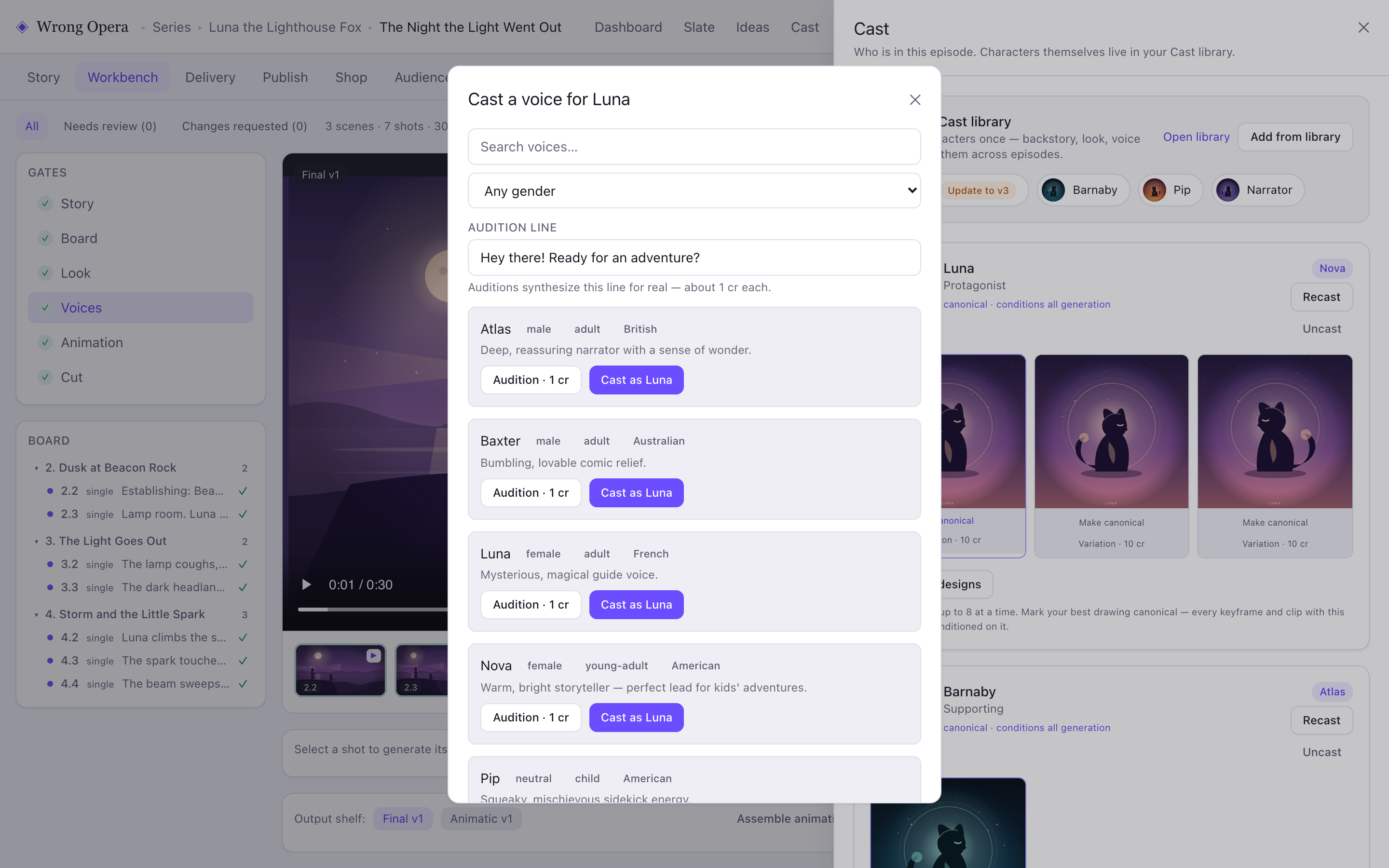
The sample voice picker shows a shared audition line and separate audition/assignment actions. No audition quality or cost result is claimed from this capture.
Real product interface captured 7 September 2026, using fictional built-in demo data. Approval notes and balances are sample data. Any animation or final-cut playback shown uses still-image fixtures, not a measured production result.
Open full-size product screen ↗Write a performance note that can travel
After choosing a direction, record its stable features and its useful range. Include pronunciation, pace, emotional restraint and phrases that demonstrate the character’s rhythm. Keep notes about a particular scene separate from traits intended to recur.
Review a new line using those notes. If the result drifts, identify whether the missing information concerns intention, pacing or sound. Replacing the whole voice should not be the automatic response to one weak delivery. Keep selected references and approved changes together so future episodes inherit a clear direction.
Questions & answers
Should every audition use exactly the same words?
Use a shared core set for comparison, then add a targeted follow-up when a candidate raises a specific question. Record why the extra test was needed.
What if two voices both work?
Try each in the scene with the most representative relationship. Choose based on the story and repeatable direction, then keep the other option documented rather than mixing traits unpredictably.
Explore the workflow with your own idea.