
Character consistency includes how someone looks, speaks, moves and reacts. A familiar face can still feel like a different person if their motivation changes without explanation. Wrong Opera supports recurring casts across stories; a clear character bible and careful review give those recurring choices a practical foundation. Generated results still need inspection.
1. Establish the person behind the design
Write a short profile covering the character's goal, fear, habits and contradiction. For example, Mara is a floating-island lighthouse keeper who distrusts shortcuts but hides a collection of improvised inventions.
Give her a recognisable decision pattern: she checks the rules first, then breaks one when protecting someone matters more. That pattern helps writers preserve her identity across different plots.
2. Make a compact visual reference
Collect agreed references for face, silhouette, proportions, costume and key props. Describe the details that matter most: Mara's oversized yellow coat, square glasses and red notebook. Separate permanent features from changeable elements such as wet clothing or a temporary injury.
Too many conflicting references create ambiguity. Choose a small set that gives a reviewer a clear answer when two shots disagree.
3. Define voice and performance direction
Record the character's speaking rhythm, typical vocabulary and emotional range. Mara might speak precisely when calm and shorten her sentences when worried. Include pronunciation notes for names and invented places.
Review a quiet exchange and an emotional scene together. A voice choice needs to work across the character's range, and consistency requires more than using the same descriptive label.
The captured Wrong Opera Cast panel offers an episode cast alongside Open library and Add from library. A character’s Recast control opens a voice picker with an audition line, filters, Audition and Cast as character actions. Put the same representative line through each audition; changing both the text and the candidate makes the comparison harder to interpret.
After selecting a voice, record the character’s reference version and a short direction note alongside the episode. The sample interface also shows a canonical visual reference. That choice supplies a reference for generation; it is not a promise of identical appearance in every shot. Review the close-up, profile and action shot together before expanding the episode.
- Record the character reference version used for this episode.
- Keep a neutral line and an emotionally difficult line for future auditions.
- Check the face, silhouette, costume and delivery across three different shot demands.
- Log rejected results and the correction, not just the selected image.
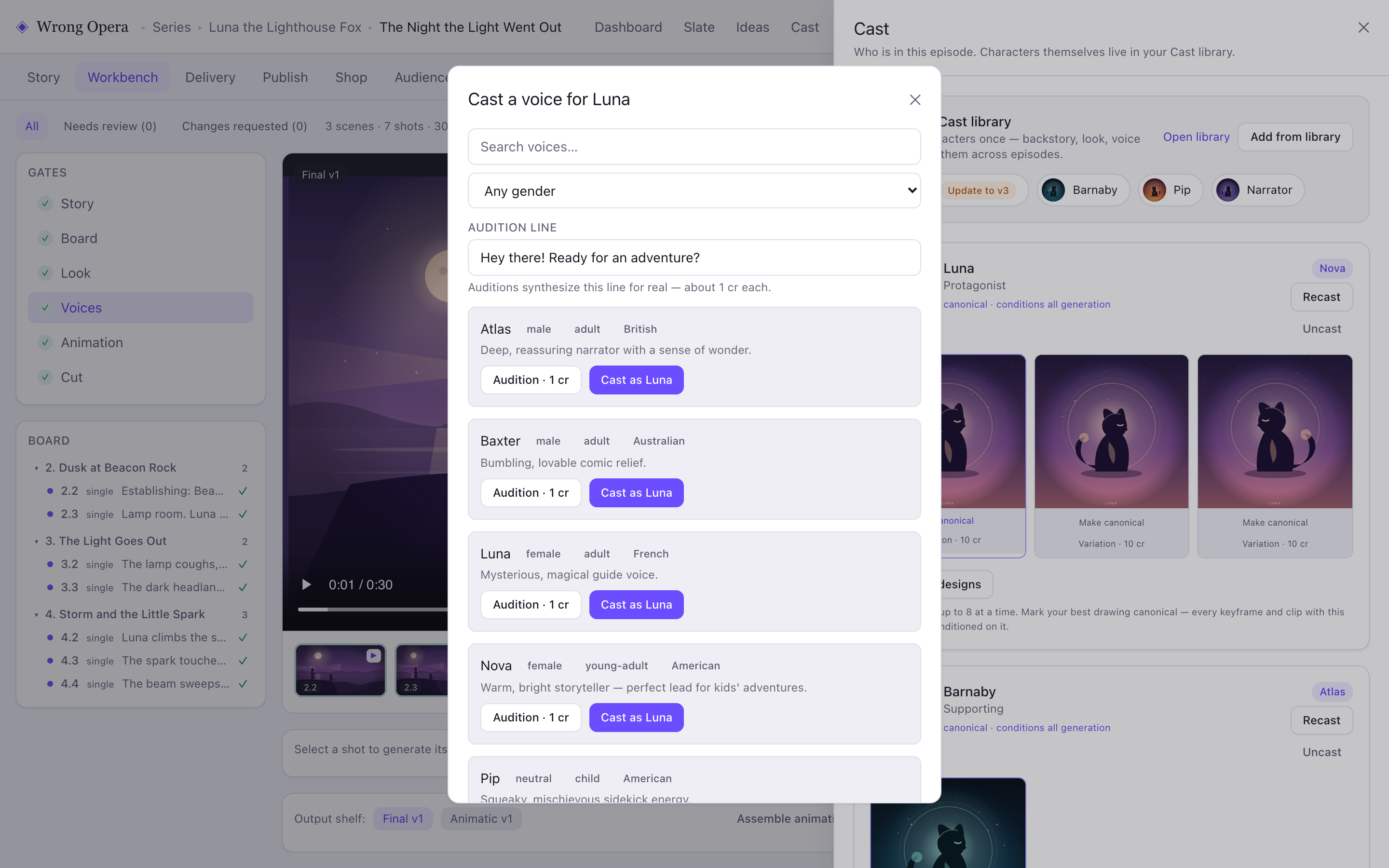
The voice picker is open over the sample Cast panel. It shows how an audition line and a character assignment can be compared without changing the written performance task.
Real product interface captured 7 September 2026, using fictional built-in demo data. Approval notes and balances are sample data. Any animation or final-cut video slot shown holds a still placeholder frame.
Open full-size product screen4. Keep an episode continuity record
After each episode, note what changed: new knowledge, damaged objects, promises, relationships and unresolved questions. If Mara learns to trust her partner, the next script should acknowledge that development even when they disagree again.
Keep this separate from permanent character traits. The goal is a recognisable person who can develop, rather than a character who forgets every event at the next opening scene.
5. Compare shots in the order viewers see them
Inspect adjacent shots for visible changes, then review a selection from the whole episode. Compare references with what is actually on screen. Prioritise mismatches that affect identity or understanding before small background differences.
A practical check combines visual and story continuity. Mara's notebook changing colour is one issue; her responding casually to a danger she previously feared is another.
- Compare face, proportions, costume and signature props.
- Check voice delivery and pronunciation.
- Confirm actions fit established knowledge and motivation.
6. Turn corrections into reusable decisions
When a review exposes ambiguity, update the reference instead of leaving the answer inside a private conversation. Record which version is approved and why an exception exists, such as a costume change for a festival episode.
At the next episode's start, revisit only the references affected by its story. This keeps continuity work focused while preserving the decisions that make the cast recognisable.
Questions & answers
Can AI guarantee identical characters in every shot?
Do not assume a guarantee. References, recurring cast choices and review support consistency, but individual results may differ. Inspect important shots and make corrections before publishing.
How detailed should a character bible be?
Start with the details that change a production decision: motivation, appearance, voice, relationships and world knowledge. Add information when a real ambiguity appears instead of writing an exhaustive biography upfront.
Can a character change across a series?
Yes. Record the cause and consequence of meaningful changes. Continuity makes development understandable; it should not prevent a character from learning, changing clothes or responding differently after an important event.
Ready to put the idea to work?