Start with the substantial overlap
LTX Studio’s official product page describes script-to-storyboard production, a timeline editor, sound design and collaboration. It also documents camera and keyframe controls and reusable elements for characters, objects and locations. Calling it only a video generator would miss the scope of its published workflow.
Wrong Opera describes six creative gates, a cast library, simulated audience testing and project review. Its five studio paths cover animation, film, TV, quiz and news. Those paths provide a useful way to frame an evaluation, but a studio label is not proof that every project requirement is supported.
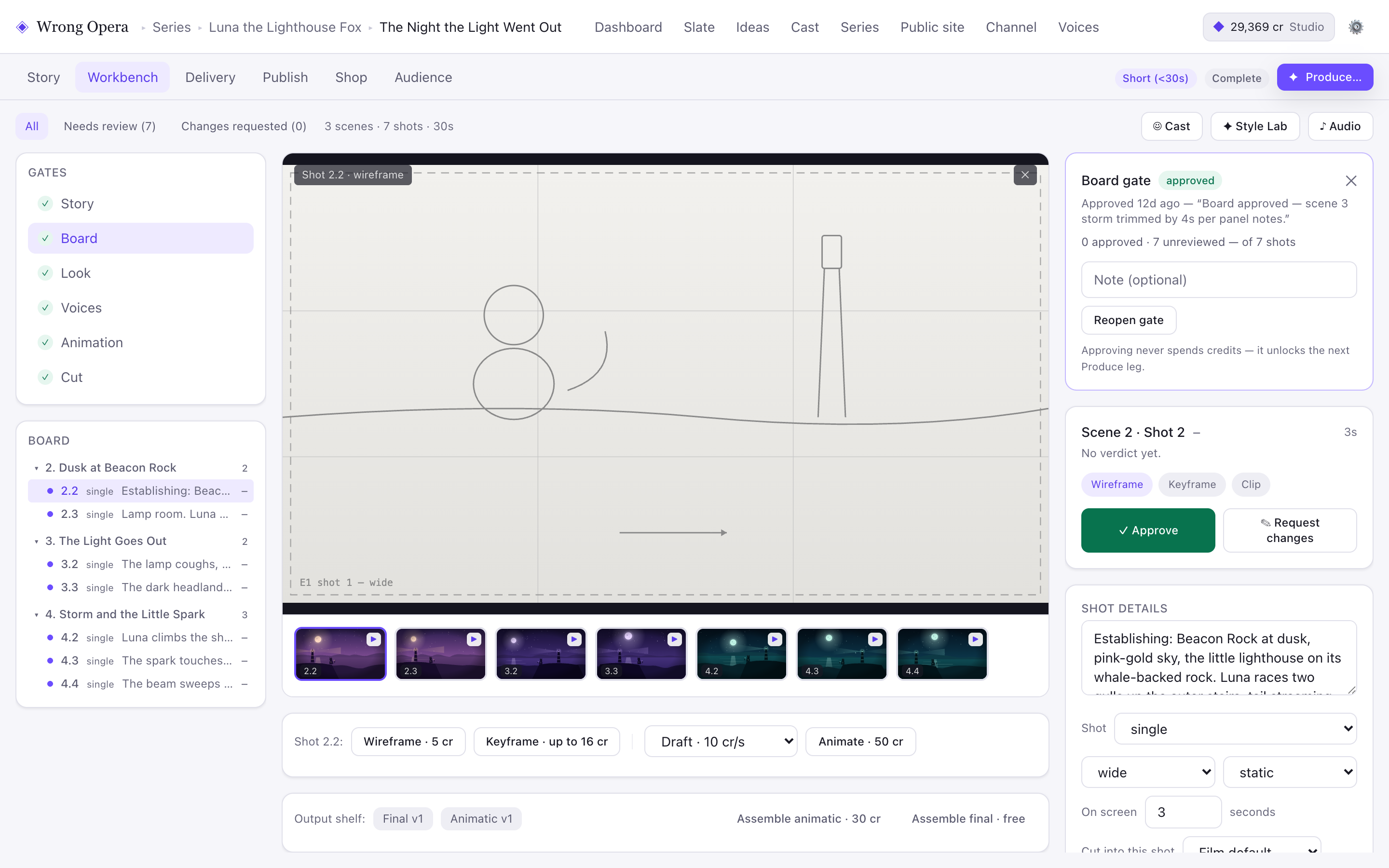
Wrong Opera’s Board gate is shown with a selected shot, review filters and per-shot approval controls. Ask both providers to demonstrate how a late change is carried through the sequence.
Real product interface captured 7 September 2026; fictional built-in project and approval data. Animation and final-cut playback in these captures use still-image fixture clips, not provider-generated animation or evidence of a completed production.
Open full-size product screen ↗Compare decisions that recur during production
Look for the point where your team currently loses context. If the bottleneck is shot direction, inspect that interaction closely. If the problem is approval ambiguity, follow a revision through all reviewers.
| Production question | LTX Studio focus | Wrong Opera focus |
|---|---|---|
| How do we direct this shot? | Camera, keyframes and visual references | Shot plan and preview review |
| How do references persist? | Reusable project elements | Studio-level cast library |
| How does a script become images? | Script input and dynamic storyboard | Story and Board approval gates |
| How do reviewers request changes? | Documented collaborative environment | Client review rooms and delivery rounds |
Documented capabilities, access and usage units
Checked on 23 September 2026. “Documented” means the provider publicly describes the capability; it is not a hands-on performance result. “Confirm” identifies a requirement this review has not established. An undocumented feature is not assumed to be absent.
| Requirement | Wrong Opera | LTX Studio |
|---|---|---|
| Production workflow | Documented: Story, Board, Look, Voices, Animation and Cut, with reusable cast references and simulated story feedback. | Documented: script-to-storyboard, timeline editing, sound design and reusable Elements for characters, objects and locations. |
| Access | Reviewed applications. The published 14-day trial includes 800 credits; trial downloads, YouTube publishing and storefront features are restricted. | Documented: free and paid tiers; commercial-use licensing and collaboration depend on the selected plan. Check those requirements before starting client work. |
| Cost unit | Published Studio offer: £499 one-time with 45,000 credits. Credits are consumed by actions, not a guaranteed amount of finished runtime; agree team scope separately. | Generation actions consume credits. A monthly allocation, a commercial-use plan and sufficient collaborators are separate buying requirements. |
| Final handoff | Confirm required export container, codec, resolution, separate audio and editable project handoffs before approval. | Confirm the same delivery specification in the intended plan; a video-download option alone does not establish every required export. |
| Production evidence | Available evidence here: real interface captures with fictional sample data. Accepted output quality, retry cost and completion time are unmeasured. | Provider documentation supports feature availability. This article does not independently establish output quality, retry cost or completion time. |
Use one script with a deliberate late change
Prepare a one-page original scene in which a courier gives a sealed parcel to the wrong person. Limit it to two characters, one location and four planned shots. Include an appearance sheet and a note that the mistaken identity must be understandable without explanatory narration.
First review the boards. Then change the parcel to a visibly fragile object. This modification should affect handling, shot selection and perhaps the performance. Ask the operator to identify every affected decision before regenerating anything. Record whether the team can locate the approved references and explain the new revision to someone joining late.
When each becomes the stronger candidate
LTX Studio deserves close evaluation when the team wants its documented visual controls, dynamic storyboard and reusable elements in one production environment. Wrong Opera deserves close evaluation when the team wants its gate structure and format-specific editorial paths alongside story development.
Use the same acceptance checklist: the handoff is legible, characters remain recognisable, the fragile object behaves plausibly and the replacement shot fits the cut. Count the effort needed to reach acceptance. Neither product’s marketing page establishes your final output quality, model reliability or approval speed; those require your own bounded test.
LTX Studio is a close workflow alternative, so evaluate both against the same script and late change. Decide whether reusable Elements and timeline controls, or Wrong Opera’s explicit approval gates and simulated story feedback, better support the decisions your team makes repeatedly.
Questions & answers
Is this a comparison of LTX Studio and the LTX model?
No. It compares the LTX Studio production application with Wrong Opera. A model and a production application are different evaluation units.
Should a team test every feature?
Start with the decisions that determine whether your representative scene can be approved. Expand only when an unresolved requirement could change the selection.
Sources & further reading
References for this article, checked for publication on 23 September 2026. Product details can change; confirm the requirements for your project with the provider.
Evaluate the workflow with your production team.