What each product documents
Wrong Opera connects Story, Board, Look, Voices, Animation and Cut, with a reusable cast library and simulated audience feedback. Its value proposition is keeping decisions about a production together, including collaborators and client review.
Runway’s official getting-started guide describes Tools, Apps, Agent and Workflows. Agent supports conversational production of multi-shot videos, while Workflows provides a node-based creative pipeline. Its Edit Studio documentation describes changes to existing footage using Aleph 2.0. These are meaningful workflow capabilities, not merely isolated clip generation.
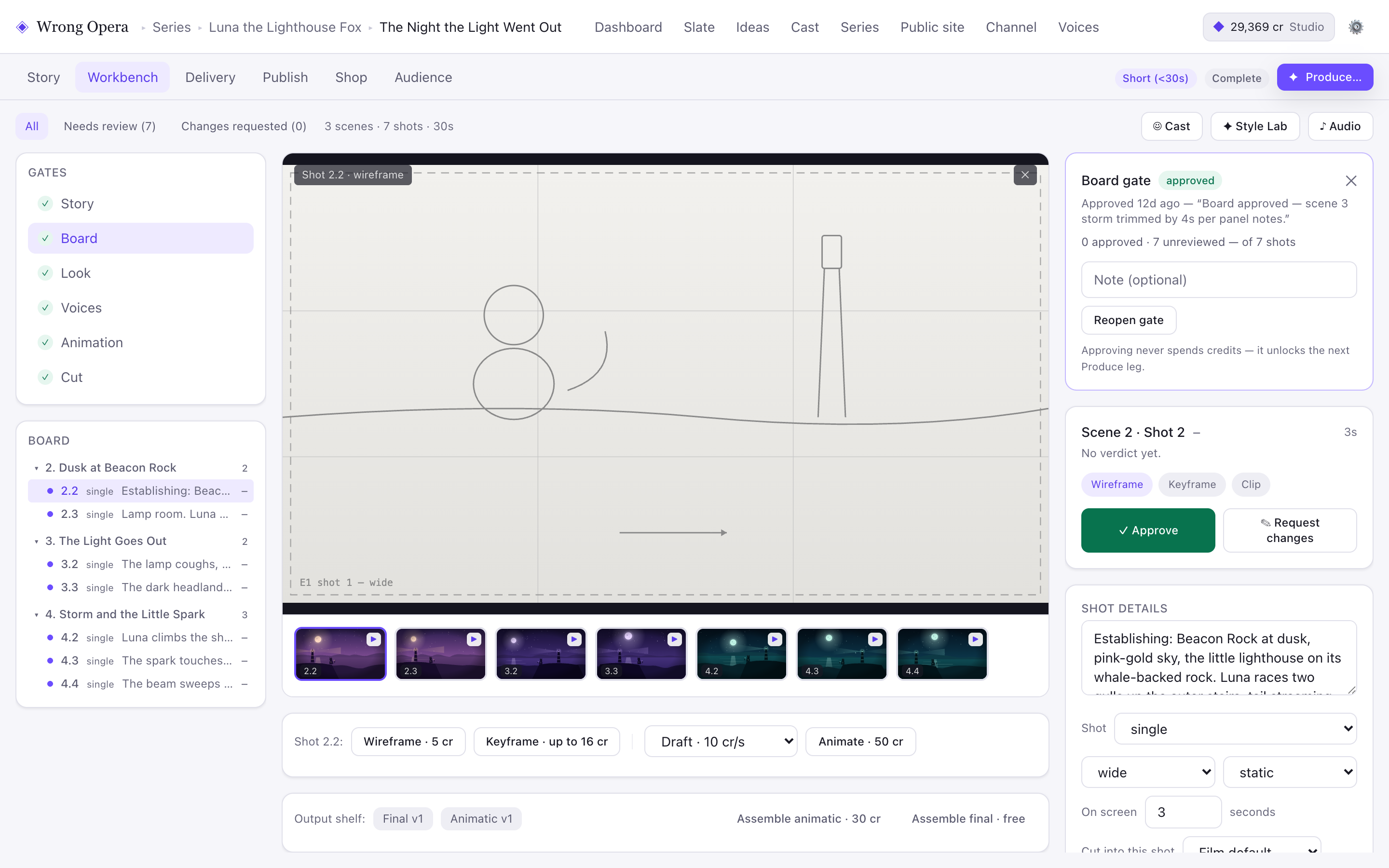
In Wrong Opera’s Board screen, the selected shot has Wireframe, Keyframe and Clip views, plus Approve and Request changes controls. This is the approval structure to examine during a matched-brief evaluation.
Real product interface captured 7 September 2026; fictional built-in project and approval data. Animation and final-cut playback in these captures use still-image fixture clips, not provider-generated animation or evidence of a completed production.
Open full-size product screen ↗Choose a starting point
The following choices are evaluation priorities, not exclusive capabilities. A team may develop a story in one environment and produce particular assets elsewhere, subject to checking the actual handoff.
| Your immediate need | Start by evaluating | Evidence to request |
|---|---|---|
| Revise an existing filmed shot | Runway Edit Studio | Preservation of the details you must retain |
| Keep premise, cast and approvals connected | Wrong Opera | A revision traced from Story to Cut |
| Build a custom generation pipeline | Runway Workflows | A working version of your proposed graph |
| Develop a recurring fictional cast | Both products | The same character across three different scenes |
Documented capabilities, access and usage units
Checked on 23 September 2026. “Documented” means the provider publicly describes the capability; it is not a hands-on performance result. “Confirm” identifies a requirement this review has not established. An undocumented feature is not assumed to be absent.
| Requirement | Wrong Opera | Runway |
|---|---|---|
| Production workflow | Documented: Story, Board, Look, Voices, Animation and Cut, with reusable cast references and simulated story feedback. | Documented: generation tools, conversational Agent, node-based Workflows and footage transformation in Edit Studio. |
| Access | Reviewed applications. The published 14-day trial includes 800 credits; trial downloads, YouTube publishing and storefront features are restricted. | Documented: free account with 125 one-time credits; paid subscriptions add monthly credits. Model and collaboration access vary by plan. |
| Cost unit | Published Studio offer: £499 one-time with 45,000 credits. Credits are consumed by actions, not a guaranteed amount of finished runtime; agree team scope separately. | Generation credits vary with model, duration and resolution. Do not compare a Runway credit directly with a Wrong Opera credit. |
| Final handoff | Confirm required export container, codec, resolution, separate audio and editable project handoffs before approval. | Confirm the same delivery specification in the intended plan; a video-download option alone does not establish every required export. |
| Production evidence | Available evidence here: real interface captures with fictional sample data. Accepted output quality, retry cost and completion time are unmeasured. | Provider documentation supports feature availability. This article does not independently establish output quality, retry cost or completion time. |
Run a three-shot lighthouse test
Use an original brief: a keeper enters a dark lighthouse, finds a damaged switch and restores the beam. Supply the same approved character reference and three shot descriptions. Ask for an establishing image, a hand interacting with the switch and a reaction. These different demands make the exercise more informative than a single atmospheric shot.
After the initial review, change the switch from red to brass while preserving the action and the keeper’s costume. Record which references must be updated, how rejected takes are identified and whether the final sequence still explains the action. This is a proposed evaluation, not a reported test result.
Judge the revision path as well as the image
Keep an evaluation sheet with accepted shots, rejected attempts, review time, generation usage and unresolved continuity errors. Give story clarity and editability explicit weights before seeing the outputs. A beautiful image that cannot connect to the next shot may not meet this brief.
Runway may be the better fit when an established editor needs a particular transformation or configurable generation process. Wrong Opera may fit a team whose main difficulty is carrying narrative decisions through approval. Confirm export requirements, access and current commercial terms with each provider; this comparison does not establish integration compatibility.
Start with Runway when a particular footage transformation or configurable generation pipeline is the purchasing trigger. Bring the actual shot and a revision request. The comparison should establish whether Wrong Opera’s story and approval structure is useful enough to justify another workspace.
Questions & answers
Does Runway only make isolated clips?
No. Its official documentation includes Agent for multi-shot work and Workflows for custom pipelines, alongside generation and editing tools.
Which makes better-looking films?
This desk research cannot establish that. Compare accepted sequences using your references, motion requirements and revision brief, and judge the assembled result.
Sources & further reading
References for this article, checked for publication on 23 September 2026. Product details can change; confirm the requirements for your project with the provider.
Evaluate the workflow with your production team.