State what kind of cut you are reviewing
Before playback, identify the version and its intended level of finish. Explain which images or sounds are temporary and which decisions are ready for approval. This prevents a discussion of placeholder texture from consuming the time needed to resolve a missing story beat.
Keep the brief available, but do not narrate the film while reviewers watch. They need to experience what is actually on screen. For a fictional short about a missed train, the first question might be whether the traveller’s final decision is understandable without explaining the backstory.
Use the first pass for understanding
Watch from beginning to end without pausing. Record the points where you felt uncertain, lost interest or changed your interpretation. Afterward, describe the story in a few sentences. A gap between the intended story and that description identifies something to investigate.
Distinguish productive uncertainty from accidental confusion. Wondering why a character hides a message may create interest; failing to notice the message at all may prevent the next scene from making sense. The correction depends on which experience the cut creates.
Give each later pass a narrow purpose
Review continuity in sequence, then sound and readability. Keeping these passes separate reduces the chance that a small visual flaw distracts from a larger structural issue. Name the location of each observation and the effect it has on the viewer.
The following review plan is a suggested workflow, not a promise that every cut needs the same number of rounds.
| Pass | Question | Useful output |
|---|---|---|
| Story | Can I follow the goal, change and outcome? | A small set of information gaps. |
| Continuity | Do actions, positions and identities connect? | Specific shot-pair notes. |
| Sound and text | Can I understand the words and necessary labels? | Precise clarity corrections. |
| Finish | What remains distracting after those fixes? | Prioritised polish requests. |
Agree the purpose of the next version
Sort findings into approval blockers, valuable refinements and optional experiments. Choose a manageable set for the next cut and state how you will judge the changes. Do not ask the team to solve every possible variation at once.
Keep a note of successful moments that should survive revisions. When the new cut arrives, compare it with the original issue and watch enough surrounding context to catch knock-on effects. Close resolved notes explicitly so each round moves the project towards a finish instead of reopening all decisions.
The captured Cut view places the current output above the shot strip and provides an output shelf with Final v1 and Animatic v1. Use the named version when sending a note, then select the relevant shot to investigate an issue. The Cut gate has its own state and Reopen gate action, so a final sequence decision can be distinguished from a shot decision.
This capture contains a still-image fixture video. It demonstrates the arrangement of the controls but cannot prove pacing, animation quality, sound or the correctness of an export. During a real evaluation, watch the full moving sequence with sound and verify the delivered file in the application or device that will receive it. Record those checks against the actual output version.
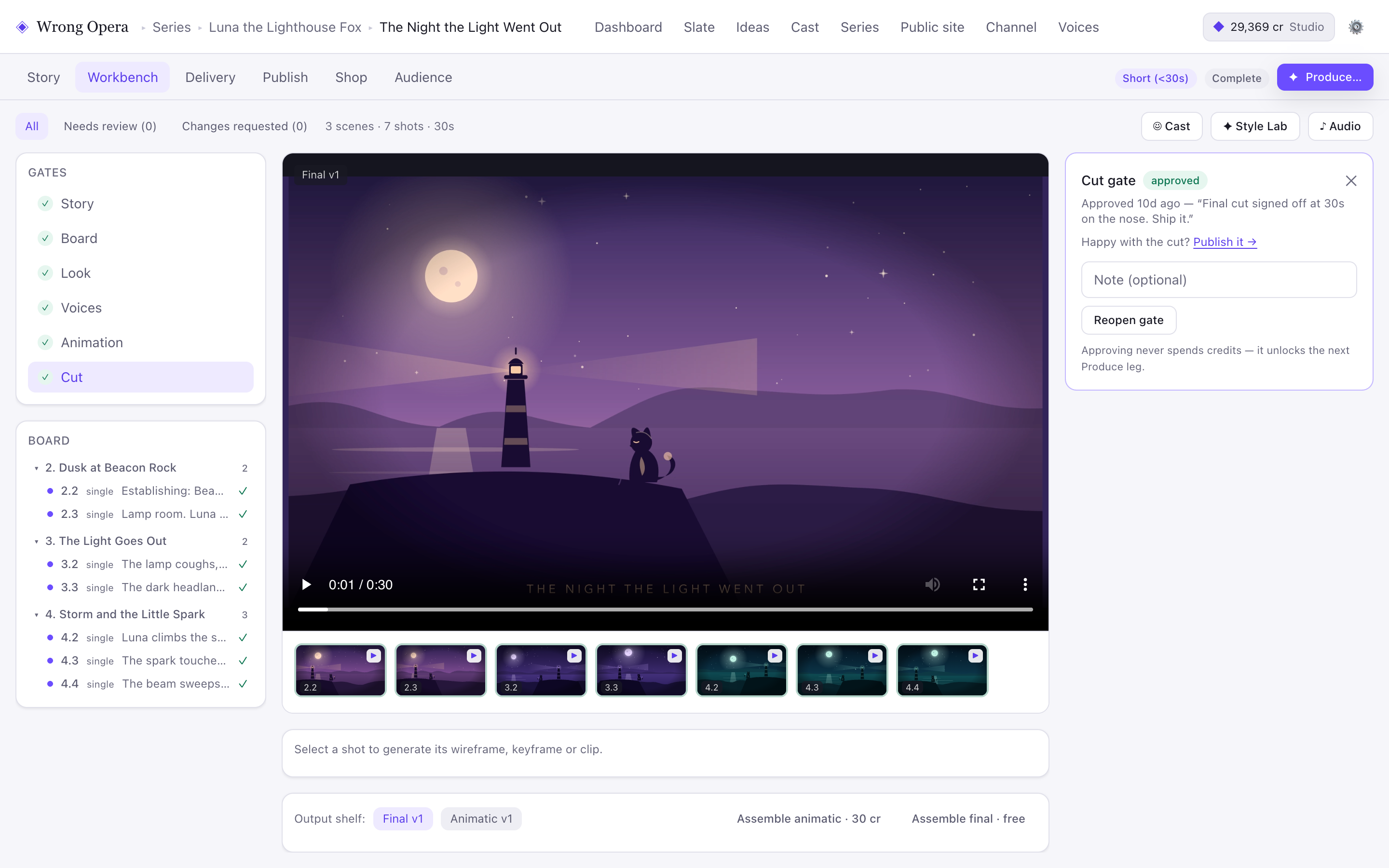
The Cut interface shows a named output, shot strip and final approval state. Playback in this fictional sample is a still-image fixture, not a finished production.
Real product interface captured 7 September 2026, using fictional built-in demo data. Approval notes and balances are sample data. Any animation or final-cut playback shown uses still-image fixtures, not a measured production result.
Open full-size product screen ↗Questions & answers
Should reviewers watch separately first?
An individual first pass can preserve independent reactions before a group discussion shapes them. Bring those observations together afterward and let the decision owner resolve conflicting priorities.
What if the rough cut reveals a weak premise?
Name the structural issue directly and decide whether a bounded rewrite is justified. Do not disguise a new story brief as a long list of small editing notes.
Explore the workflow with your own idea.