Match the product to the communication task
Synthesia’s official feature page documents expressive and personal avatars, AI voices, translation, screen recording and collaboration. It also describes interactive elements and learning-oriented delivery such as SCORM export. Availability depends on the relevant feature and plan; this comparison does not treat every item as universally included.
Wrong Opera connects writing, boards, casting, production and editing across five studio formats. Its cast library and six creative gates make narrative development a useful evaluation focus. Its Quiz Studio follows a question, voting and reveal format; that description should not be assumed equivalent to every learning-management requirement.
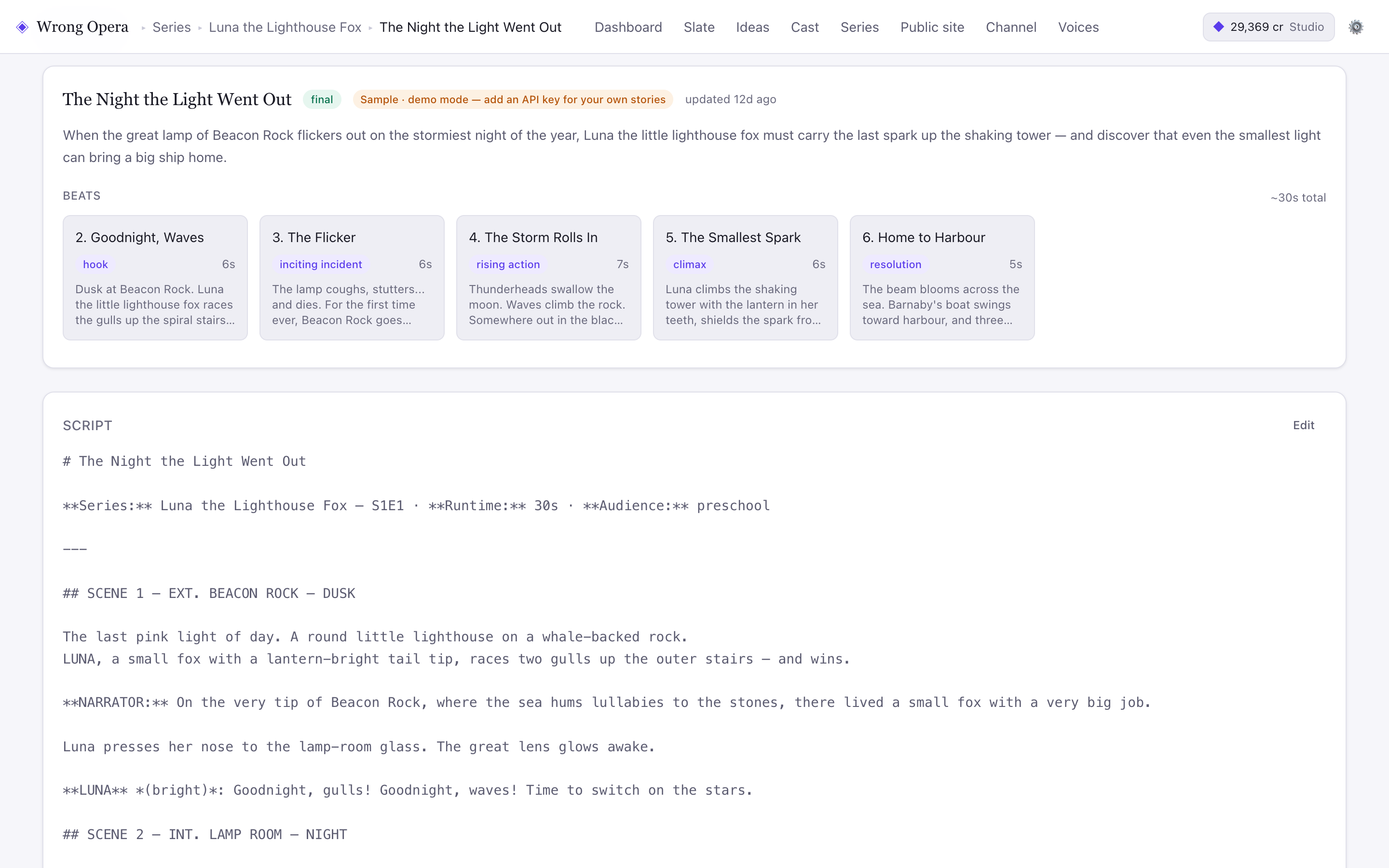
Wrong Opera’s Story screen places the premise, timed beats and screenplay together. The visible sample is a fictional narrative, illustrating the type of development task this comparison addresses.
Real product interface captured 7 September 2026; fictional built-in project and approval data. Animation and final-cut playback in these captures use still-image fixture clips, not provider-generated animation or evidence of a completed production.
Open full-size product screen ↗Separate presentation requirements from story requirements
A video can contain both a host and dramatic scenes. List which component carries the actual learning or persuasion before deciding which workflow should be primary.
| Requirement | Promising starting point | Check before choosing |
|---|---|---|
| Repeatable presenter-led instruction | Synthesia | Pronunciation, updates and localisation review |
| Recurring fictional characters | Wrong Opera | Appearance, performance and scene continuity |
| Learning-platform package | Synthesia | The exact delivery format and plan |
| Audience voting in a quiz show | Wrong Opera Quiz Studio | Participation timing and reveal behaviour |
Documented capabilities, access and usage units
Checked on 23 September 2026. “Documented” means the provider publicly describes the capability; it is not a hands-on performance result. “Confirm” identifies a requirement this review has not established. An undocumented feature is not assumed to be absent.
| Requirement | Wrong Opera | Synthesia |
|---|---|---|
| Production workflow | Documented: Story, Board, Look, Voices, Animation and Cut, with reusable cast references and simulated story feedback. | Documented: avatar-led videos, AI dubbing and plan-dependent interactive videos. Its team plans address repeatable business communication. |
| Access | Reviewed applications. The published 14-day trial includes 800 credits; trial downloads, YouTube publishing and storefront features are restricted. | Documented: Basic is free; paid Starter enables downloads. Editor/guest seats and live collaboration differ by plan. |
| Cost unit | Published Studio offer: £499 one-time with 45,000 credits. Credits are consumed by actions, not a guaranteed amount of finished runtime; agree team scope separately. | Shared AI credits cover usage-based features, with published video-minute and dubbing equivalents. Seats and eligible features also affect the plan choice. |
| Final handoff | Confirm required export container, codec, resolution, separate audio and editable project handoffs before approval. | Confirm the same delivery specification in the intended plan; a video-download option alone does not establish every required export. |
| Production evidence | Available evidence here: real interface captures with fictional sample data. Accepted output quality, retry cost and completion time are unmeasured. | Provider documentation supports feature availability. This article does not independently establish output quality, retry cost or completion time. |
Try one topic in two deliberately different forms
Choose a low-stakes topic such as preparing a community garden workday. Make a sixty-second presenter briefing with three clear instructions. Separately outline a short scene in which two recurring characters discover why tools must be returned to their marked places. Both should communicate the same three points.
Ask reviewers what they understood and what action they would take. Record whether the dramatic version clarifies the topic or merely adds production work. Then change one instruction and inspect the update process. This reveals whether you primarily need reliable information maintenance, narrative engagement or a mixture.
Make the choice around maintenance and comprehension
Synthesia may fit an organisation whose main challenge is producing and maintaining structured presenter videos. Wrong Opera may fit a creator developing a fictional format in which character choices carry the message. These are inferences from the documented workflows, not performance rankings.
For either option, review names, jargon, caption readability and the relationship between spoken instructions and visible action. Confirm required languages and delivery formats directly instead of extrapolating from a headline. If internal approval or access administration matters, demonstrate those requirements explicitly; Wrong Opera’s published project collaboration should not be read as a promise of enterprise SSO or organisation roles.
Start with Synthesia when the deliverable is a maintained presenter-led explanation, training asset or localised business video. Start with Wrong Opera when the brief depends on fictional characters making choices across scenes. A talking-avatar sample and a narrative scene answer different production questions.
Questions & answers
Can Synthesia include more than a talking presenter?
Yes. Its official feature page includes generated visuals, screen recording and interactive elements. Judge the complete workflow against your intended programme.
Does Wrong Opera replace an LMS authoring tool?
That is not established by the published product information. Bring the exact package, reporting and integration requirements to an evaluation.
Sources & further reading
References for this article, checked for publication on 23 September 2026. Product details can change; confirm the requirements for your project with the provider.
Evaluate the workflow with your production team.